
New Research Paper: Investigating Climate–Ecosystem Imbalance
A new Ecology Letters article authored in part by our own Dr. Joey Bernhardt tackles a challenge that is becoming central to how we understand the effects of climate change on ecosystems: the disconnect between environmental conditions and the biological communities that live in them.
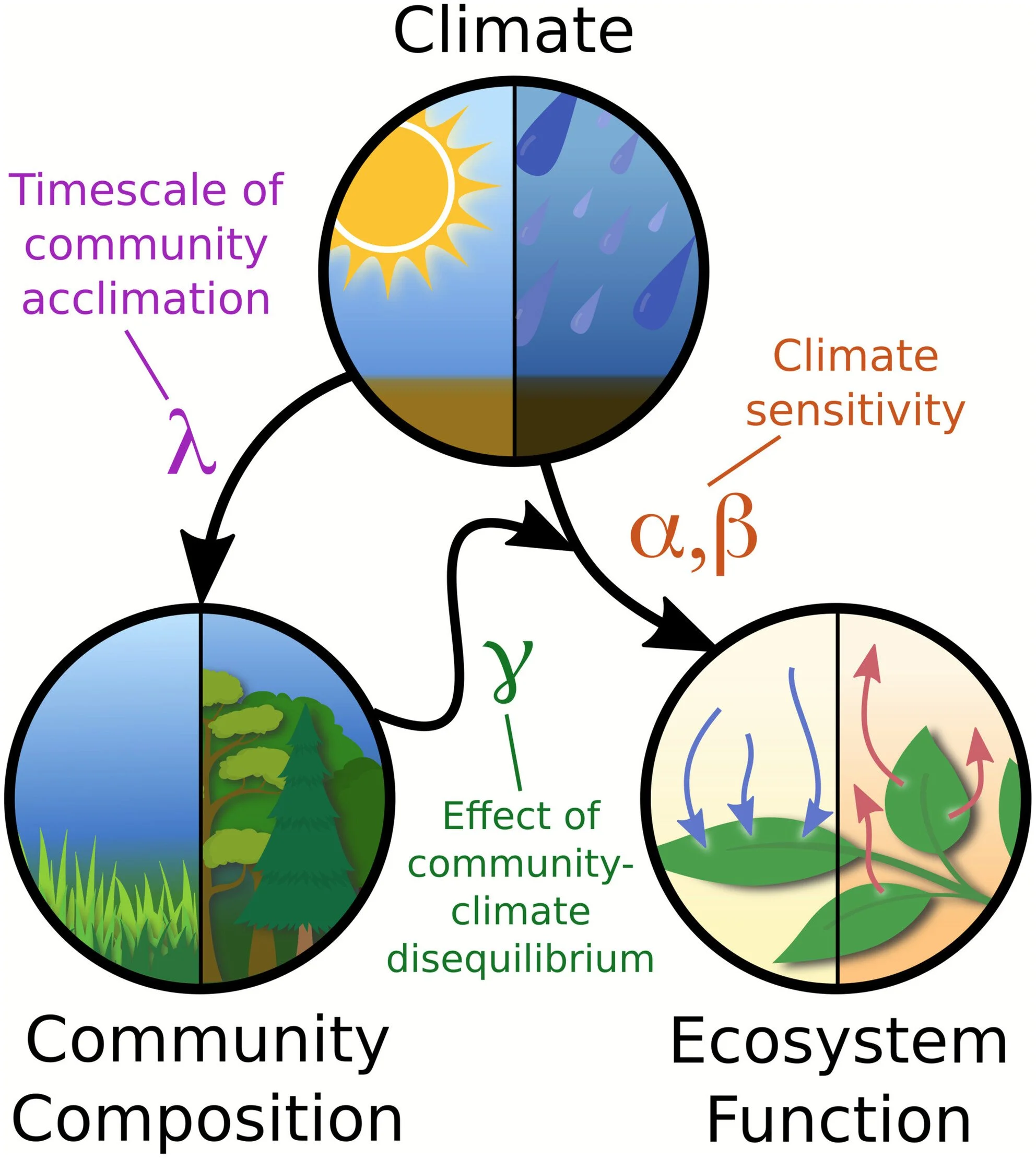
Above: A conceptual representation of the relationships between climate, community composition, and ecosystem function. Communities respond directly to climate change through community acclimation, and ecosystem function is sensitive to climatic variation and change. Disequilibrium between communities and the climate modifies the climate sensitivity of ecosystem function.
The concept of their paper — titled “Linking community-climate disequilibrium to ecosystem function” — is that ecological communities often fail to keep pace with the speed of climate change. That is, the species composition in a forest, wetland, or grassland often reflects past climates rather than current ones. Ecologists call this mismatch community-climate disequilibrium. The authors indicate that this mismatch doesn’t just matter for understanding where species occur — it also affects how well ecosystems perform functions we care about, like productivity, nutrient cycling, or carbon storage.
One strength of the paper is that it presents a simple, theory-based framework linking (1) how quickly communities adjust to changing climates and (2) how that lag influences ecosystem function. They show that if community change lags behind climate change — for example, slow-turnover tree communities in a warming region — you can see temporary reductions in ecosystem function even if long-term conditions would support higher productivity. In other words, ecosystem function can dip as species catch up to new climatic norms. This insight is critical because many current forecasting tools assume that communities are in equilibrium with climate — an assumption this work challenges.
By fitting their model to long-term records of climate and ecosystem performance, the authors suggest that it is possible to detect when communities are out of sync with climate without needing detailed data on individual species’ ranges or climate tolerances—a major advantage in real-world management settings where such information is often unavailable.
In sum, this paper provides a conceptual bridge between climate-driven community dynamics and ecosystem function — with clear implications for anticipating and managing ecological responses to rapid environmental change. It encourages managers to think not just about the direction of change (e.g., warming) but about the rate at which communities can realistically track that change, and how that lag shapes the delivery of ecosystem services.
Stemkovski, M., Cortez, M. H., Bernhardt, J. R., Bladen, K. K., Bradford, J. B., Clark-Wolf, K., Evans, M. E. K., Johnson, L. C., Lynch, A. J., Pastore, M. A., Pinsky, M. L., Rollinson, C., Selmoni, O., Walker, A. P., Williams, J. W., & Adler, P. B. (2026). Linking community-climate disequilibrium to ecosystem function. Ecology Letters, 29(1), e70314.