
Connecting Ecological Research Across Continents: Dr. Koya Hashimoto’s Visit to the CEM
Not to be outdone by his partner, Dr. Mito Ikemoto, Dr. Koya Hashimoto of Hirosaki University (Japan) also contributed to the CEM’s international research collaborations during their recent visit together. While both visited the Centre, Hashimoto connected with CEM Director Dr. Kevin McCann to explore how changes in species interactions and fish population dynamics can offer insights into the health and changing state of Great Lakes ecosystems. His work adds another perspective to the collaborative research linking scientists in Japan and Canada.
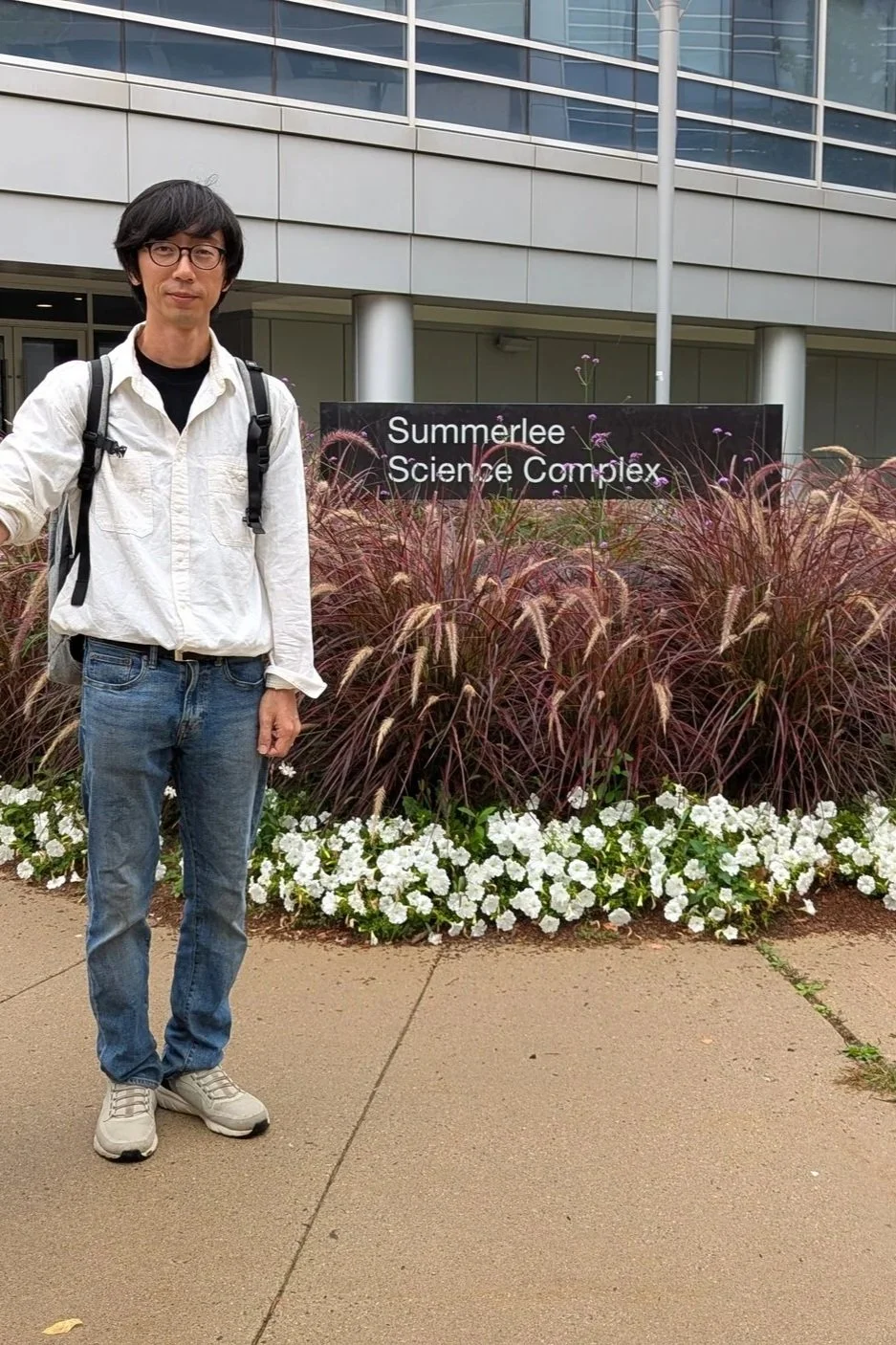
Pictured: Dr. Hashimoto visits the Centre for Ecosystem Management in the University of Guelph’s Summerlee Science Complex , enjoying a chance to connect with researchers and explore new opportunities for international collaboration.
Hashimoto is an empirical ecologist who studies species interactions in terrestrial and freshwater ecosystems. Fascinated by the diversity of insects, particularly butterflies, he completed his PhD researching competition among butterfly caterpillars. His broader research explores how biodiversity is maintained and how disturbances, including human-driven changes, can alter ecological communities. Since 2023, he has led the Laboratory of Ecological Interactions at Hirosaki University, investigating how relationships among species shape the dynamics of natural systems.
Hashimoto’s collaboration with the CEM grew out of connections facilitated by his former supervisor, Dr. Taku Kadoya of Japan’s National Institute for Environmental Studies, who introduced him to CEM Director Dr. Kevin McCann. McCann subsequently invited Hashimoto to join the project exploring food-web rewiring in the Great Lakes. Their work focuses on the population dynamics of two ecologically important fish species, walleye and yellow perch, asking whether changes in their population dynamics can reveal shifts in the state of lake ecosystems. During his visit, Hashimoto and McCann also met with Dr. Yingming Zhao of the Ontario Ministry of Natural Resources (MNR) to exchange ideas and discuss the research.
A central challenge in ecology is that disturbances can ripple through networks of species interactions, producing indirect effects that are difficult to predict. To investigate these complexities, Hashimoto uses Empirical Dynamic Modelling (EDM), a nonlinear time-series approach that can help researchers identify causal relationships, estimate the strength of species interactions, and predict near-term ecological dynamics using observational data. This approach complements the CEM’s interest in understanding how interactions within food webs influence ecosystem stability and change, offering new ways to investigate how ecological communities respond to shifting conditions.
Although Hashimoto has now returned to Japan, the collaboration continues as the researchers develop a manuscript based on their work. His visit highlights how international research partnerships connect expertise across countries and disciplines, advancing the CEM’s efforts to understand the interconnected processes that shape ecosystems.