
New Research: How Heat Tolerance Shapes Everyday Performance in a Warming World

Study co-author and CEM postdoctoral fellow, Dr. Amanda Cicchino
Predicting how species will respond to rising temperatures is still a major challenge in ecology. A big part of this comes down to understanding how temperature affects how well organisms function, especially for ectotherms (cold-blooded animals). As the climate warms, scientists often rely on two different ways to understand how species respond to temperature. One looks at how well organisms perform across a range of temperatures (for example, how fast they grow or move). The other focuses on their upper thermal limit—the point at which they can no longer function. A study (pre-print) led by one of our postdoctoral fellows, Dr. Amanda Cicchino, brings those two ideas together by asking whether they are actually connected, and helps resolve a long-standing debate about how useful maximum heat tolerance (CTmax) is for understanding how vulnerable species are to rising temperatures.
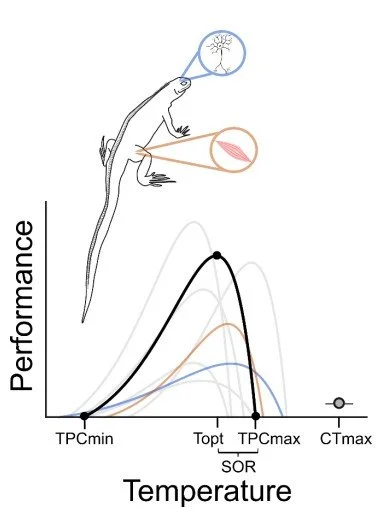
Conceptual illustration of a thermal performance curve (TPC) in black depicting key TPC traits, including the minimum and maximum performance temperature (TPCmin, TPCmax, respectively), the optimal temperature (Topt), and the supra-optimal range (SOR: the range between TPCmax and Topt). The critical thermal maximum (CTmax) is indicated for reference and typically occurs at temperatures exceeding those associated with optimal or maximal performance. The aggregation of underlying temperature-dependent processes results in the emerging TPC for a single integrated measure of performance (7). For example, the TPC for running speed (shown in black) reflects the effects of contributing physiological processes (grey), including muscular (orange) and neuronal (blue) performance. TPCs were drawn using hypothetical parameters and the Thomas 2012 model (29) of thermal performance.
Looking across more than 100 ectothermic species, the authors find that CTmax is not just a hard limit where organisms suddenly fail at extreme temperatures. Instead, it is closely linked to how well they perform at lower, non-lethal temperatures. Species that can tolerate higher maximum temperatures also tend to have higher optimal temperatures for performance, higher peak performance temperatures, and a broader range of temperatures over which they can continue to function.
That said, not all biological processes respond in the same way. Short, intense activities—like quick bursts of movement—track closely with heat tolerance. In contrast, metabolic processes—like growth, feeding, and respiration—show a weaker relationship with CTmax. As a result, in species that can tolerate very high temperatures, there is a growing gap between the temperature where metabolism works best and the temperature they can ultimately survive. This suggests that key metabolic functions are partly controlled by different processes than those reflected by CTmax.
Overall, the study shows that while heat tolerance and everyday performance are connected, the relationship depends on what kind of activity you’re looking at and over what timescale. It also indicates that heat tolerance (like CTmax) is more than just a limit—it reflects how organisms function across temperatures. For researchers and natural resource managers, this means it can be a practical and informative tool for predicting how species will respond to warming, especially when full performance data are unavailable.
Cicchino, A. S., Collier, J., Bieg, C., Davis, K., Ghalambor, C. K., Robey, A. J., Sunday, J. M., Vasseur, D., & Bernhardt, J. R. (2026). Temperature-dependent performance scales with maximum heat tolerance across ectotherms. bioRxiv. https://doi.org/10.64898/2026.03.21.713427
This study was the result of a working group supported by the Canadian Institute for Ecology and Evolution/ Institut Canadien d’Écologie et d’Évolution and the University of Guelph’s Centre for Ecosystem Management. This work was also supported by the Natural Sciences and Engineering Research Council of Canada.