
The Edge of What’s Possible: How Hidden Trade-Offs Shape Evolution
Understanding how species evolve to occupy different ecological “niches” has long hinged on a simple but elusive idea: trade-offs. Organisms can’t be good at everything, and these limitations help explain why biodiversity persists. But in practice, those trade-offs are surprisingly hard to detect—because high-performing organisms often appear good at multiple things at once, masking the underlying constraints. In a new preprint co-authored in part by our postdoctoral fellow Dr. Jason Laurich and research chair Dr. Joey Bernhardt, that problem is tackled using a concept named after Vilfredo Pareto and borrowed from economics: Pareto fronts, which is a way of describing the best possible trade-offs between competing objectives when you can’t optimize everything at once.
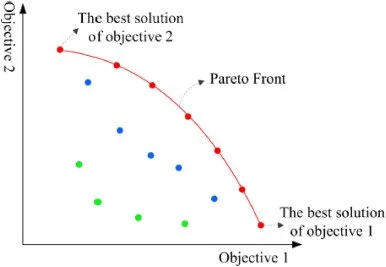
Above: Illustration of Pareto optimal front and solutions (Yang, Zhu, Shao, & Chi, 2018: https://doi.org/10.3390/ijgi7020063)
Imagine different species of phytoplankton, which is what this study focuses on. Some grow very quickly but only under ideal conditions; others grow slowly but can tolerate harsh environments (like high salinity or low nutrients). If you plot growth rate on one axis and stress tolerance on the other, you might see a curve forming the upper edge of what’s achievable. Points along that curve are the Pareto front. A species on that front could only improve its growth rate by becoming less stress-tolerant, or vice versa. Species below the curve are “leaving performance on the table”—they could, in theory, evolve to do better in one or both traits.
By experimentally evolving populations of Chlamydomonas reinhardtii under different stresses (like limited nutrients or high salinity), the researchers examined how traits such as growth rate, nutrient requirements, temperature tolerance, and salt tolerance change together. Rather than relying on simple correlations, they used Pareto fronts to reveal hidden constraints. The key insight: even when traits appear positively related, there are still hard limits on how much organisms can optimize multiple functions at once. In other words, organisms can improve along several dimensions—but only up to a boundary beyond which further gains require sacrifices elsewhere.
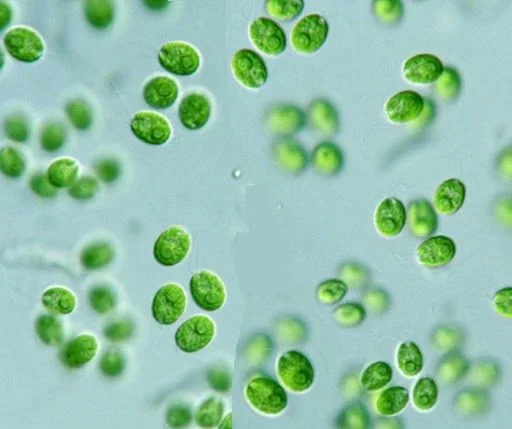
Above: Chlamydomonas reinhardtii
The structure of these constraints turned out to matter. When traits were loosely linked or moved in the same direction, populations tended to evolve toward these optimal boundaries. But when traits were in conflict, evolution stalled—suggesting that the geometry of trait relationships can shape not just what is possible, but what actually happens over time. The authors then scaled up their analysis, compiling data across nearly 300 phytoplankton taxa. Even across vast evolutionary timescales, similar boundaries emerged, indicating that these constraints are not just short-term quirks of laboratory evolution but enduring features of biological systems.
Taken together, this work offers a fresh way to think about evolution: not just as a process of adaptation, but as one navigating a landscape of hard limits. By revealing trade-offs that traditional methods often miss, Pareto fronts provide a clearer picture of why organisms are the way they are—and why they can’t simply become “perfect” under multiple environmental pressures. For a world facing rapid environmental change, this framework may also help predict how species can—and cannot—adapt to increasingly complex conditions.
Laurich, J. R., Narwani, A., and J.R. Bernhardt. (2026). Pareto fronts reveal constraints on the evolution of niche-determining traits in phytoplankton (Preprint; Version 1). bioRxiv.
This work was supported by a Natural Sciences and Engineering Research Council of Canada (NSERC) Discovery Grant and a Canada First Research Excellence Fund Grant. Work during the experimental phase of this study was supported by a Nippon Foundation Nereus Postdoctoral Fellowship (Joey Bernhardt).