
New Research: Resilience, Rewiring, and the Future of Ecosystems

Above: CEM postdoctoral fellow and lead author, Dr. Charlotte Ward
Ecologists have often treated species interactions within ecological networks as relatively fixed, where predators eat certain prey, pollinators visit certain flowers, and ecosystems function according to a recognizable set of relationships. But new research led by ecologists at the Centre for Ecosystem Management (University of Guelph) - in collaboration with the DFO’s Dr. Tyler Tunney - argues that ecological networks are highly dynamic and species and their interactions routinely reorganize in response to environmental variation. This reorganization is referred to as “ecological network rewiring”, which occurs as species alter who they interact with, how strongly they depend on certain resources, and whether they remain part of a given network at all.
The review highlights that rewiring can sometimes act to enhance the resilience of ecosystems. Species that are flexible in their behaviour can adapt to environmental change by shifting habitats, altering diets, or forming new interactions. For example, pollinators may switch to different flowering plants throughout a season to track more abundant resources, and predators within food webs may broaden their diets or habitat usage when access to their preferred prey declines. These adjustments can help ecosystems remain stable, but the authors stress that there are limits. Human-driven environmental change is increasingly directional and persistent, unlike the natural variability ecosystems evolved with. As landscapes become simplified and climate extremes intensify, ecological networks may lose the diversity and flexibility that once allowed them to reorganize dynamically in response to changing conditions.
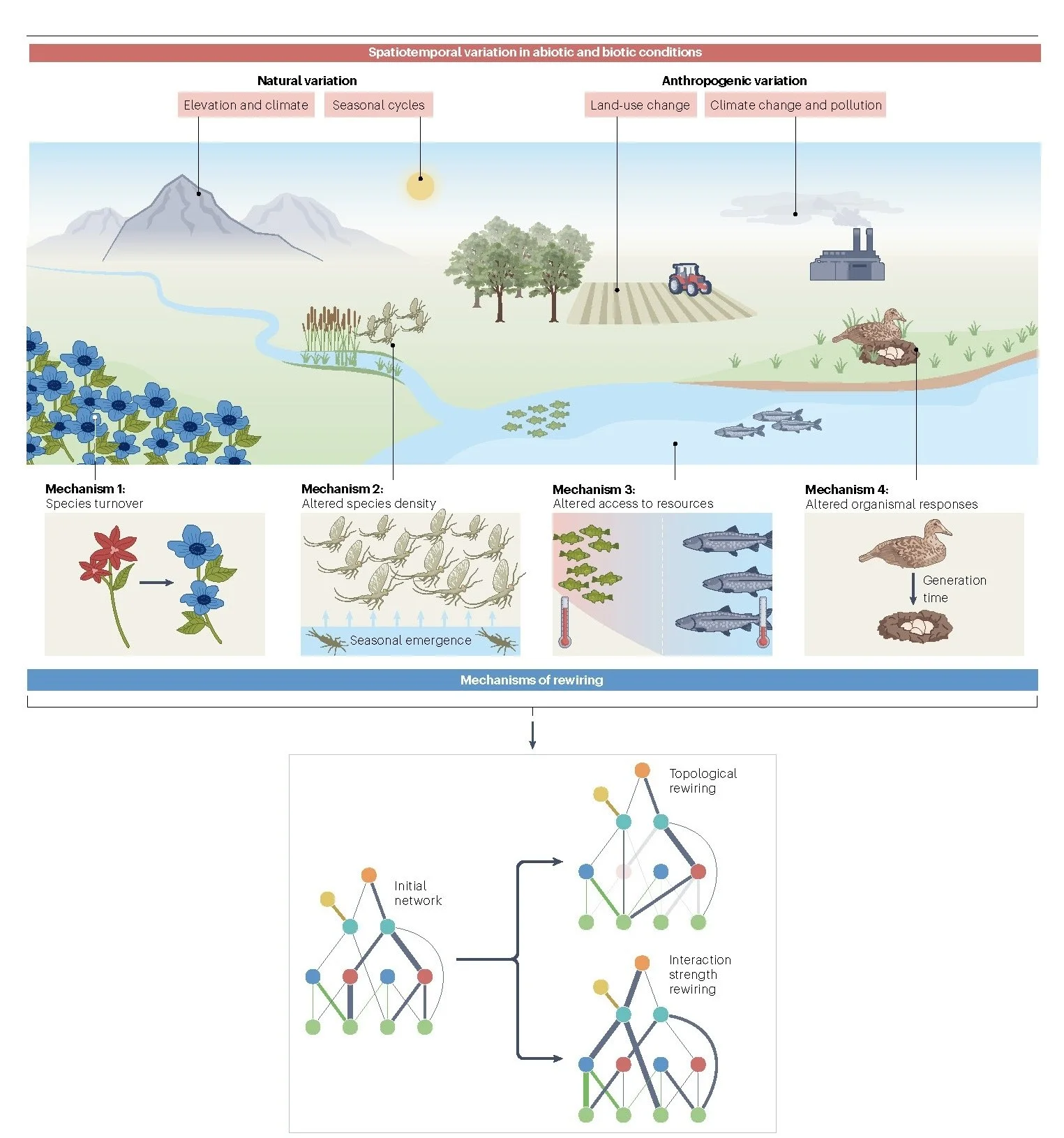
Above: Figure depicting mechanisms of ecological network wiring in response to environmental change. Spatiotemporal variation in abiotic and biotic conditions rewires ecological networks by modifying species and their interactions. These changes occur through four general mechanisms: (1) changes in diversity or species turnover, in which shifts in community composition lead to the gain or loss ofspecies and their associated links; (2) changes in the density of species, in which environmental changes influence species’ performances and thus population sizes, eliciting behavioural responses by resources (such as antipredator strategies) and consumers (such as foraging decisions); (3) altered access to resources, in which physical or abiotic changes in environmental conditions affect which species can interact or how frequently they interact; and (4) altered organismal responses, in which changing conditions drive individuals to modify their form, physiologyor behaviour to balance trade-offs in a changing environment. Such changes can include altered body size, metabolic rate or generation times, which can cascade to affect both the presence and strength of species interactions. Reproduced from Ward et al. (2026), Nature Reviews Biodiversity.
Rewiring is particularly relevant for ecosystem-based management and conservation, as traditional management approaches often assume relatively stable relationships between predators, prey, and habitats, yet this perspective of rewiring means those relationships can shift rapidly under both natural and human-driven environmental pressures. The paper ultimately argues for a stronger “network-thinking” approach to management — one that tracks not only which species are present, but how energy, nutrients, and ecological relationships move through ecosystems over time.
More broadly, the paper clarifies the mechanisms that drive rewiring by highlighting how the process can be both natural and beneficial. The danger comes when environmental change pushes ecosystems toward simplified, homogenized networks dominated by a few species and strong ecological interactions. For ecologists, this represents a conceptual framework to understand how biodiversity and ecosystems functions can be maintained in a highly variable and rapidly changing world.
This research was made possible as a result of the financial support of Fisheries and Oceans Canada, as well as NSERC and the NSF.
Charlotte A. Ward, Tyler D. Tunney, Kayla R. S. Hale, Reilly F. O’Connor, & Kevin S. McCann. (2026). The rewiring of ecological networks in a variable world. Nature Reviews Biodiversity.