
Tracking Algal Toxins: Implications for Fisheries and Ecosystems
Harmful algal blooms (HABs) are becoming an increasingly serious problem in lakes worldwide, driven largely by nutrient runoff from agriculture and urban development. A new study out of Dr. Fred Laberge’s lab (affiliate) which was co-authored by our director, Dr. Kevin McCann, delved into how one particular neurotoxin, β-methylamino-L-alanine (BMAA), and its related compounds — N-(2-aminoethyl) glycine (AEG), 2,4-diaminobutyric acid (DAB), and β-amino-N-methylalanine (BAMA) — move through the food web in Lake Erie. The team sampled a range of organisms, from tiny zooplankton and mussels to forage fish, yellow perch, and walleye near Point Pelee, Ontario, in order to track how these toxins accumulate in different species and tissues over time.
The results revealed a complex picture. BMAA itself was detected in about a quarter of samples, but its chemical relatives were much more common: AEG appeared in over 90% of samples, DAB in nearly half, and BAMA in more than 70%. Even more concerning, these toxins weren’t confined to water or the gut of fish — they were found in critical tissues, including the brains of forage fish and yellow perch. Patterns of concentration differed between species and across tissues, showing that the way these toxins are absorbed and processed can vary throughout the food web.
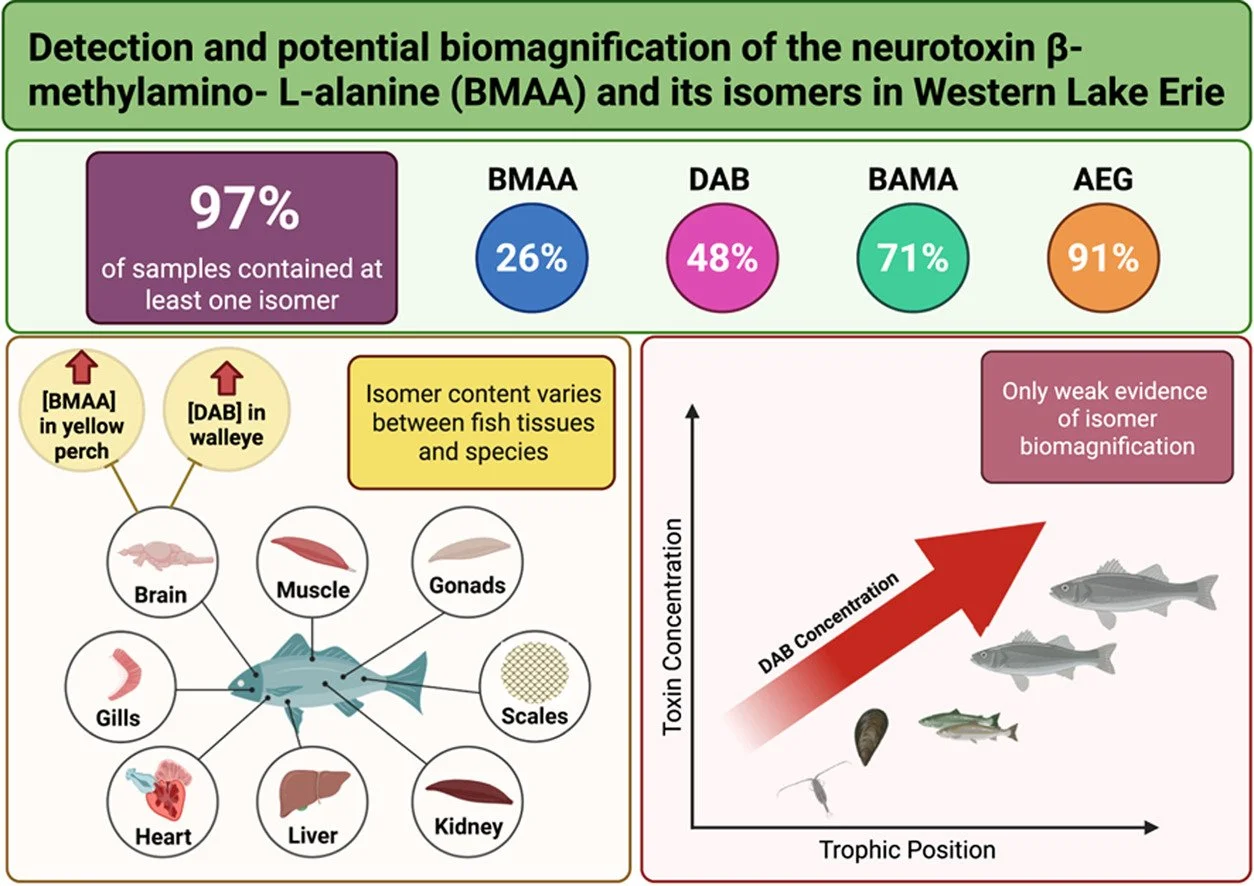
For fisheries and natural resource managers, these findings are particularly important. The study provides some evidence that DAB may biomagnify (i.e. increase as it moves up the food chain). While this effect was less clear when considering adult fish alone, it signals a potential risk: even if BMAA itself is relatively rare, its related compounds could pose a hidden threat to fish populations. This is especially relevant given the Canada-Ontario Lake Erie Action Plan, which identifies HABs as a serious environmental and economic challenge (Ministry of the Environment and Climate Change Canada, 2018). The plan highlights the potential for HAB toxins to disrupt Lake Erie’s commercial fisheries thereby reducing catches and introducing risks to human health through consumption, creating significant economic consequences.
This research underscores why monitoring programs need to look beyond the presence of HABs to the full suite of toxins they release, and why management strategies must consider how these compounds move through ecosystems. Protecting riparian habitats, reducing nutrient runoff, and maintaining vigilant toxin monitoring are not just environmental best practices — they are key to safeguarding fish communities, supporting sustainable fisheries, and keeping Lake Erie’s ecosystem resilient.
Amanda M. Reside, Pawanjit Kaur Sandhu, Julia Solonenka, Susan J. Murch, Kevin S. McCann, Nicholas J. Bernier, Frédéric Laberge (2026). Detection and potential biomagnification of the neurotoxin β-methylamino-L-alanine (BMAA) and its isomers in Western Lake Erie. Toxicon: Volume 274.