
Biodiversity Hotspots and Beyond: Trophic Hotspots Are Where It’s At
Fernandes, T.J., Hale, K.R.S., McMeans, B.C. et al. Trophic hotspots as a perspective for understanding and managing ecosystem function. Nat Ecol Evol (2026). https://doi.org/10.1038/s41559-026-03158-3
Ecosystems are incredibly variable in space and time. At any given time, some places can become centres of intense ecological activity as nutrients or energy accumulate and animals gather to take advantage of them. These places—researchers call them trophic hotspots—can be surprisingly important to how ecosystems function. In a new perspective published in Nature Ecology & Evolution, Centre for Ecosystem Management (CEM) postdoctoral fellows Dr. Timothy Fernandes and Dr. Kayla Hale, along with their colleagues at the University of Toronto and Department of Fisheries & Oceans, bring together ideas from food-web, community and animal-movement ecology to propose a common framework for understanding these dynamic hotspots.
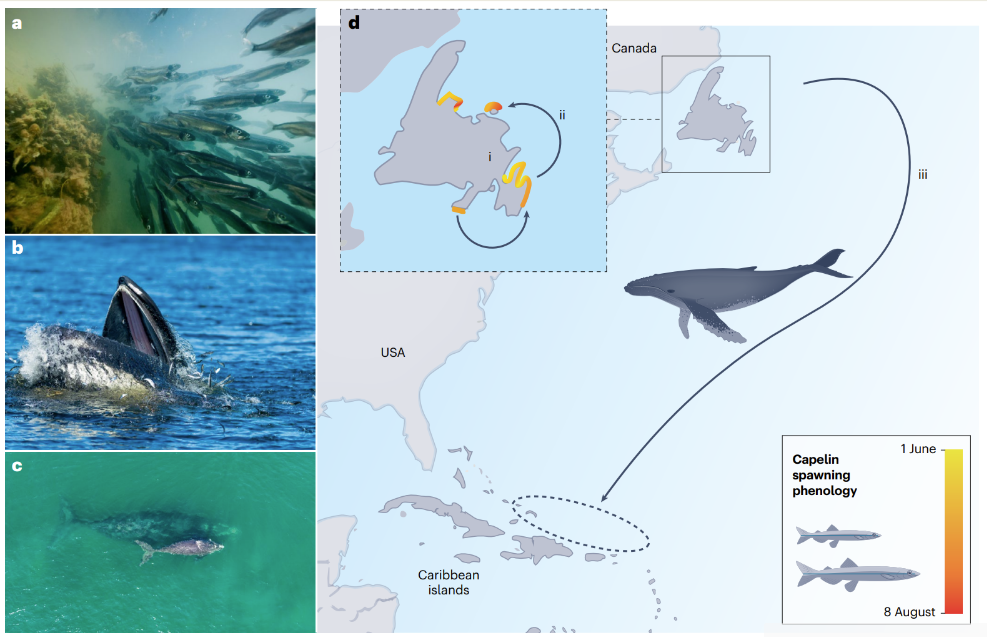
Above: Capelin create a trophic hotspot that fuels ocean ecosystems. Along the Newfoundland coast, spawning capelin (a) create a seasonal concentration of energy and nutrients that attracts mobile predators such as humpback whales (b). During the spawning season, capelin make up about 90% of humpback whales’ diet. The whales then carry that capelin-derived energy south to the Caribbean (c), where their waste and other biological material deliver nutrients to tropical waters. In this way, a seasonal concentration of capelin can influence ecosystem processes hundreds or even thousands of kilometres away (d). Image credits: a, Paul/Adobe Stock; b, Dolores Harvey/Adobe Stock; c, marabelo/Adobe Stock.
The idea is broader than the familiar concept of a biodiversity hotspot. Rather than being defined by a high number of species in a particular location, a trophic hotspot emerges when energy or limiting nutrients become concentrated, and animals move in ways that redistribute those resources through the food web. This can happen in very different ecosystems: marine upwelling zones concentrate nutrients that support productive food webs; mineral licks concentrate nutrients used by terrestrial animals; and mass migrations can transport resources between ecosystems. The authors argue that these examples are manifestations of the same fundamental ecological process: the concentration and movement of resources and consumers across space and time.
For fisheries and natural-resource ecologists, this perspective highlights something that can be easy to miss when ecosystems are studied as maps of relatively fixed habitats or species distributions: where and when ecological interactions are concentrated can significantly influence ecosystem function. A trophic hotspot may be temporary, moving or highly seasonal, and its influence can extend beyond the immediate area where resources are concentrated. The authors suggest that this dynamic heterogeneity—unevenly distributed ecological activity, across both space and time—can contribute to resilience when ecosystems are disturbed. Understanding where these hotspots form, what creates them and how they connect different parts of an ecosystem could therefore provide a useful lens for understanding ecosystem function and resilience.
Broadly speaking, ecologists may need to look beyond what is present in an ecosystem and pay closer attention to where, when and how energy moves through it. Fernandes, Hale and their colleagues propose trophic hotspots as a way to connect research on animal movement, resource pulses, food webs and ecosystem resilience—areas that are often considered separately. They argue that these hotspots could also serve as focal points for proactive conservation and management, particularly as ecosystems become increasingly affected by environmental change. Instead of offering a one-size-fits-all prescription, the framework provides a way to identify the places and periods that may make disproportionately important contributions to keeping ecosystems functioning.
*This work was supported by the Natural Sciences and Engineering Research Council of Canada, the National Science Foundation (Postdoctoral Research Fellowship in Biology), and the Great Lakes Fishery Commission.
Fernandes, T.J., Hale, K.R.S., McMeans, B.C. et al. Trophic hotspots as a perspective for understanding and managing ecosystem function. Nat Ecol Evol (2026).