
When Warming Levels the Playing Field: Rethinking Competition in a Changing Climate
Davis, K. E., T. N. Grainger, P.-J. Ke, P. L. Thompson, M. I. O'Connor, and J. R. Bernhardt. 2026. General Predictions for the Effects of Warming on Competition in Ecology Letters 29, no. 6: e70395

Above: CEM postdoctoral fellow, Dr. Kaleigh Davis
Climate warming is often framed as a story about how individual species respond to changing environments. But ecosystems don’t function as a collection of isolated species; they emerge from complex patterns of species interactions. New research led by one of our postdoctoral fellows, Dr. Kaleigh Davis (with co-authors at the University of Guelph - including CEM Research Chair Dr. Joey Bernhardt - as well as the DFO, National Taiwan University and UBC), takes a step toward a more predictive understanding of these dynamics by combining Modern Coexistence Theory with the Metabolic Theory of Ecology. The result is a general framework for asking not just how species respond to temperature, but how warming changes the balance between species competing for the same resources.
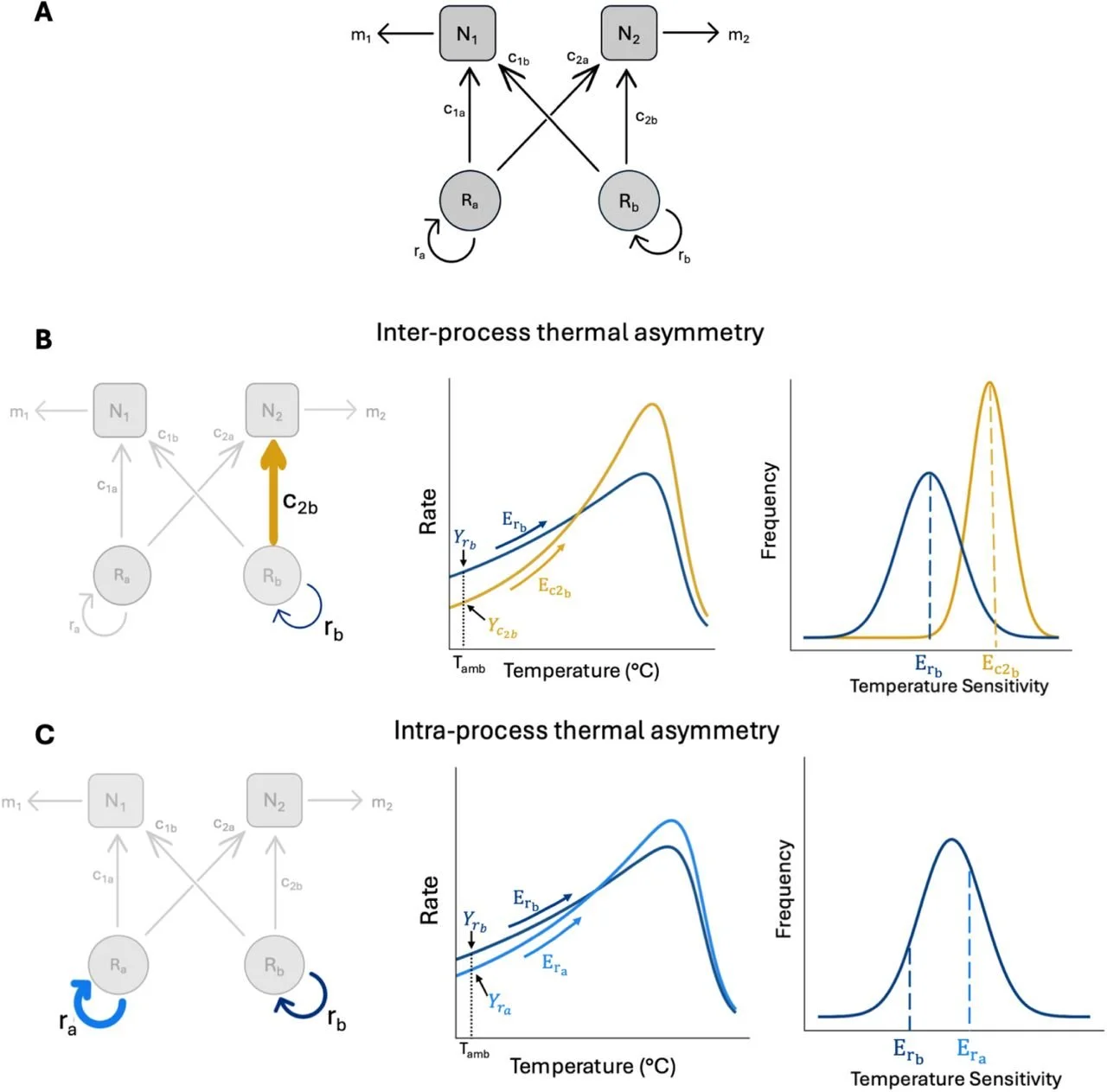
Above: A conceptual diagram of a consumer–resource model showing how temperature affects different processes, creating differences both within and between them.
Drawing on a synthesis of ecological theory and data, the study finds a surprisingly consistent pattern: as temperatures rise, the differences that typically allow species to coexist—what ecologists call “niche differences”—tend to shrink. At the same time, differences in raw competitive strength—what ecologists call “fitness differences”—also narrow. Altogether, warming appears to push competing species toward a kind of neutrality, where neither species has a strong advantage over the other. This doesn’t mean competition disappears; rather, it becomes less decisive, flattening the ecological playing field.
When species become more similar in both their roles and their competitive abilities, the consequence is that communities may become more sensitive to chance events—random fluctuations, disturbances, or small environmental changes could tip the balance. The study also emphasizes that large, dramatic shifts in competition are relatively rare; instead, warming produces small, directional nudges for most species. When dramatic shifts in competition do occur, they occur between species with very different responses to warming.
For natural resource managers, this insight reframes how we think about climate impacts. If warming tends to erode the ecological differences between species that stabilize coexistence, then maintaining diversity may depend on preserving the environmental conditions that allow species with different thermal traits to survive—factors that help sustain differences among species. Climate change may not always produce clear winners and losers, but instead may blur the distinctions that allow ecosystems to function predictably. Managing for resilience, in this context, means managing for difference—ensuring that ecosystems retain the diversity of conditions and interactions that prevent them from sliding toward ecological neutrality.
*This work was supported by the Natural Sciences and Engineering Research Council of Canada and the Department of Fisheries and Oceans.
Davis, K. E., T. N. Grainger, P.-J. Ke, P. L. Thompson, M. I. O'Connor, and J. R. Bernhardt. 2026. General Predictions for the Effects of Warming on Competition. Ecology Letters 29, no. 6: e70395.